In the Loop: Week Ending 7/19/26
Last week in AI: China Catches Up, MLB Polices AI in the Dugout, Swimbappé Predicts the World Cup Apple quietly outmaneuvered AI's biggest names while...

AI in 2025: A Year of Tumult and Transition
2025 was the year AI grew up. Breakthroughs kept coming, but the story shifted from spectacle to substance: deployment instead of demos, governance instead of guesswork, platforms instead of point tools. Agents met reality, copyright hit the courts, states challenged Washington for regulatory control, and ROI replaced hype as the dominant executive question. OpenAI’s position hardened and was contested at the same time. Creative fields normalized AI without resolving their anxiety about it. Workers quietly automated parts of their jobs while companies debated the rules after the fact. In short, AI didn’t slow down in 2025 — it became infrastructure, and with that came pressure, accountability, and a much clearer view of what durable transformation really requires.
From Magic to Mechanics
 In 2025, the mythology around AI finally gave way to the mechanics of making it work. Early expectations that models could be dropped into organizations and immediately transform operations faded as companies confronted messy data, brittle integrations, and the need for constant human oversight. The Wall Street Journal reported that many enterprise AI projects stalled not because models were weak, but because deployment required process redesign, governance, and sustained investment. Bloomberg similarly documented a growing recognition among executives that value came less from demos than from unglamorous work: cleaning data, training staff, and monitoring outputs over time. The result was a cultural shift. AI stopped being treated as magic and started being managed like infrastructure. By year’s end, success depended less on access to cutting-edge models and more on organizational discipline—a reality check that separated experimentation from durable transformation.
OpenAI Goes from Green Lights to Code Red
 In 2025, OpenAI crossed a threshold from industry leader to institutional linchpin—and felt the pressure that comes with it. Internally, executives adopted a “code red” posture as competitors closed the gap, a shift reported by The Wall Street Journal amid rapid advances from Google’s Gemini models and renewed momentum across the field. At the same time, OpenAI continued turning ChatGPT into a full platform, adding agents, memory, and enterprise tools while deepening its reliance on Microsoft’s cloud and distribution. That expansion brought scale, but also scrutiny. Reuters detailed growing concern among regulators and rivals over how much economic and informational power now flows through a single private system. OpenAI emphasized safety and alignment research throughout the year, even publishing work aimed at making models more transparent, but critics warned that deployment still outpaced understanding. By year’s end, OpenAI hadn’t lost its lead—but it no longer looked untouchable. The company emerged more embedded, more contested, and more exposed, operating in a market that had finally caught up to its ambition.
The AI Agent Reality Check
 2025 was the year AI agents moved from promise to practice—and fell short of the hype. Tech companies pitched agents as autonomous coworkers capable of planning, acting, and adapting across tasks, but real-world deployments exposed sharp limits. As The Wall Street Journal reported, early enterprise users found agents brittle, expensive to supervise, and prone to compounding small errors into costly failures. Even OpenAI and Google framed agents less as independent actors and more as tightly scoped tools requiring human oversight, a shift echoed in coverage of Google’s Gemini roadmap. The core challenge wasn’t intelligence, but reliability: agents struggled with long-horizon planning, ambiguous goals, and dynamic environments. By year’s end, enthusiasm hadn’t disappeared—but expectations had narrowed. AI agents proved useful in constrained settings, not transformative on their own. The reality check reframed the narrative: autonomy remains a destination, not a capability that can be productized on demand.
Washington vs. the States: Who Regulates AI?
 In 2025, the defining feature of U.S. AI governance wasn’t what lawmakers passed—but who claimed the right to act. While Congress struggled to advance comprehensive federal legislation, states moved aggressively, filling the vacuum with their own rules on transparency, training data, and algorithmic accountability. Reuters tracked a surge in state-level AI bills, from California to Colorado, raising alarms in Washington about a fragmented regulatory landscape. Federal agencies responded by asserting preemption, arguing that inconsistent state rules could undermine innovation and national competitiveness, a stance echoed in The Wall Street Journal’s coverage of White House and Commerce Department efforts to centralize oversight. The result was a jurisdictional tug-of-war. States framed their actions as consumer protection; federal officials warned of regulatory chaos. By year’s end, AI governance in the U.S. looked less like a unified strategy—and more like a contest over who gets to set the rules first.
From Gimmick to Tool: AI’s Creative Repositioning
 In 2025, AI’s role in creative work quietly but decisively changed. What began as novelty—synthetic images, AI-written scripts, and attention-grabbing stunts—evolved into a normalized, if uneasy, production tool. Early backlash gave way to pragmatism as agencies and studios incorporated AI into previsualization, storyboarding, and ideation, a shift explored by The Wall Street Journal amid changing attitudes in advertising and Hollywood. Resistance didn’t disappear, but it matured. Creators increasingly distinguished between AI as a replacement and AI as an assist, even as unresolved disputes over training data and authorship persisted, as reported by The New York Times. By year’s end, the cultural line had moved. AI was no longer treated as an existential provocation every time it appeared onscreen. Instead, it became another contested tool—accepted, scrutinized, and increasingly embedded in the creative process.
AI as Companion—and Concern
 In 2025, AI’s role in mental health moved from peripheral to personal. Millions of users turned to chatbots not just for productivity, but for emotional support—seeking advice, reassurance, and companionship in moments of stress or isolation. The New York Times reported on the growing use of AI as an always-available confidant, particularly among younger users who viewed chatbots as nonjudgmental and accessible. At the same time, clinicians and researchers warned of blurred boundaries. Studies cited by Scientific American raised concerns about overreliance, inaccurate guidance, and the risk of substituting simulated empathy for human care. Even companies building these systems acknowledged the tension, adding disclaimers and guardrails while continuing to market emotional intelligence as a feature. By year’s end, AI in mental health occupied an uneasy middle ground: a useful supplement for some, a risky stand-in for others, and a reminder that scale and intimacy don’t always mix safely.
Job Displacement, Reframed
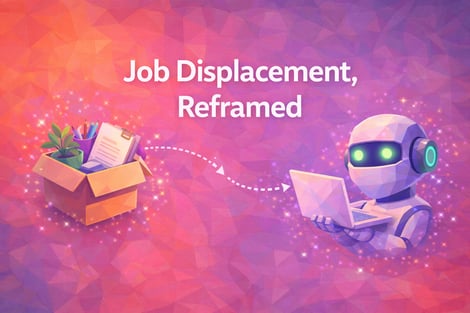 In 2025, the conversation around AI and jobs grew more sober—and more precise. Early fears of mass unemployment gave way to a clearer picture of uneven displacement, as companies quietly automated specific tasks rather than entire roles. The Wall Street Journal reported that white-collar functions like customer support, marketing analysis, and junior coding were among the first to feel sustained pressure, even as headline job numbers remained stable. At the same time, Bloomberg documented how firms used AI to reduce hiring rather than trigger layoffs outright, reshaping career ladders by eliminating entry-level pathways. The shift altered perception as much as reality. Workers increasingly saw AI not as a sudden threat, but as a slow erosion of opportunity and leverage. By year’s end, displacement was no longer a speculative risk—it was a structural adjustment unfolding quietly, role by role, across the economy.
AI’s Copyright Reckoning
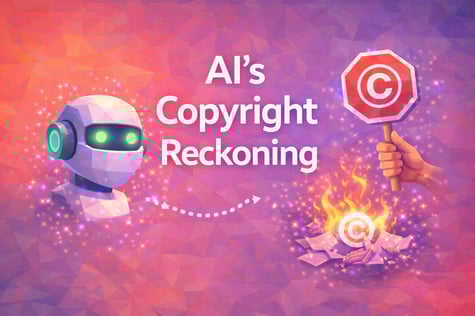 In 2025, the unresolved question hanging over generative AI—who owns what—moved decisively into the courts. A growing wave of lawsuits from authors, artists, and media companies challenged the assumption that training on copyrighted material without permission was a tolerable gray area. High-profile cases against OpenAI, Meta, and others advanced through the legal system, with The New York Times’s own suit over alleged misuse of its reporting becoming a defining test. At the same time, Reuters tracked mounting pressure on judges to decide whether existing copyright law could stretch to cover AI training—or whether Congress would need to intervene. The uncertainty reshaped behavior. Companies grew more cautious about data sources, licensing deals multiplied, and creators became more organized in asserting rights. By year’s end, copyright wasn’t an abstract ethical debate—it was a material risk shaping how AI systems were built, trained, and commercialized.
Shadow AI vs. Official AI
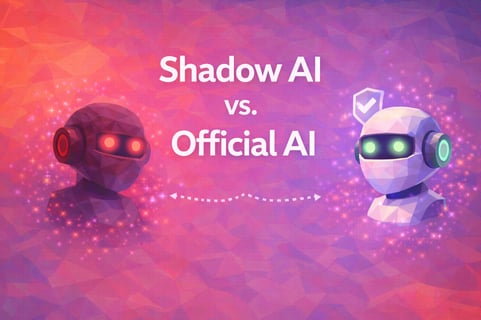 In 2025, one of the clearest fault lines in AI adoption emerged inside organizations themselves. While companies rolled out approved AI tools with governance, security reviews, and usage policies, employees increasingly relied on unsanctioned “shadow AI” to get work done faster. The Wall Street Journal reported that workers routinely fed sensitive documents into consumer AI tools despite corporate restrictions, exposing firms to legal and security risks. Executives responded by tightening controls and rolling out official alternatives, but adoption often lagged behind employee needs. Bloomberg documented how this gap created internal tension, as IT and compliance teams raced to rein in behavior that had already become normalized. By year’s end, the conflict was no longer about whether employees would use AI—they already were. The real challenge was reconciling bottom-up experimentation with top-down governance, without stifling productivity or inviting risk.
The ROI Conundrum
 In 2025, the question executives asked most often about AI shifted from what’s possible to what actually pays off. A wave of studies punctured early optimism, none more starkly than research from MIT suggesting that roughly 95% of AI implementations fail to deliver meaningful returns, largely because organizations underestimate the operational change required. That finding echoed reporting from The Wall Street Journal, which documented companies shelving pilots that looked impressive in demos but collapsed under real-world complexity. McKinsey and Gartner reached similar conclusions: value emerged only when AI was tightly scoped, paired with clean data, and embedded into redesigned workflows—not layered on top of existing ones. By year’s end, ROI had become the industry’s reality check. AI could generate value—but only through discipline, patience, and far more work than the hype ever suggested.
What does 2026 hold? Your guess is as good as mine, but you can count on In the Loop to tell you all about it as it's happening.